Start your NDIS support business, without the back-office overwhelm
Whether you're registering as an independent support worker or building a registered NDIS provider from the ground up, Caretora gives you bookings, invoicing, claims and audit-ready compliance tracking in one app — scaled to where your business is today.
Steps to get started
- 1
Set up the business
Register for an ABN, decide a business structure (sole trader is the common starting point for independents), and set up basic bookkeeping before your first booking.
- 2
Arrange insurance
Public liability and professional indemnity insurance are the usual baseline — many participants and plan managers will ask to see proof before booking you.
- 3
Complete worker screening checks
An NDIS Worker Screening Check (or your state/territory equivalent) is standard practice working with NDIS participants, registered or not.
- 4
Decide: register, or stay unregistered
Not every path needs NDIS Commission registration — see the NDIS registration guide for what actually requires it and what doesn't.
- 5
Set up your systems
Bookings, invoicing/claims, and record-keeping — decide this before you're juggling three different tools for your first real client.
Costs
Insurance, worker screening, and — if you register — an independent auditor's fee are the main costs, and they vary enough by provider and circumstance that a single figure here would be more misleading than useful. Get a direct quote for insurance, and see the NDIS registration guide for how registration costs actually work if that path applies to you.
Checklist
- ABN registered
- Business structure decided
- Public liability and professional indemnity insurance arranged
- Worker screening check completed
- Decision made on NDIS Commission registration
- Bookings, invoicing and record-keeping system in place
- Service agreement template ready for new participants
FAQ
Do I need to be a registered NDIS provider to start?
No — you can support self-managed, and often plan-managed, participants without NDIS Commission registration. See the NDIS registration guide for what specifically does require it (supported independent living and NDIS digital platform services do, from 1 July 2026).
How much does it cost to get started?
The real costs vary a lot by path — insurance, worker screening, and (if you register) an independent auditor's fee are the main ones. There's no single fixed figure, and anyone quoting one exact number without knowing your situation is guessing — get quotes for insurance and, if relevant, an audit, rather than budgeting off an estimate from a page like this one.
What should I set up first — admin systems or finding clients?
Both matter, but it's worth having invoicing and record-keeping sorted before your first booking rather than after — reconstructing early sessions' notes and invoices from memory a month in is avoidable admin pain.
However you're starting out
The same platform, scaled to where your business actually is.
Independent support worker
Delivering support yourself, invoicing participants or plan managers directly.
- Easy invoicing and NDIS claims, built from the session itself
- One calendar for every booking
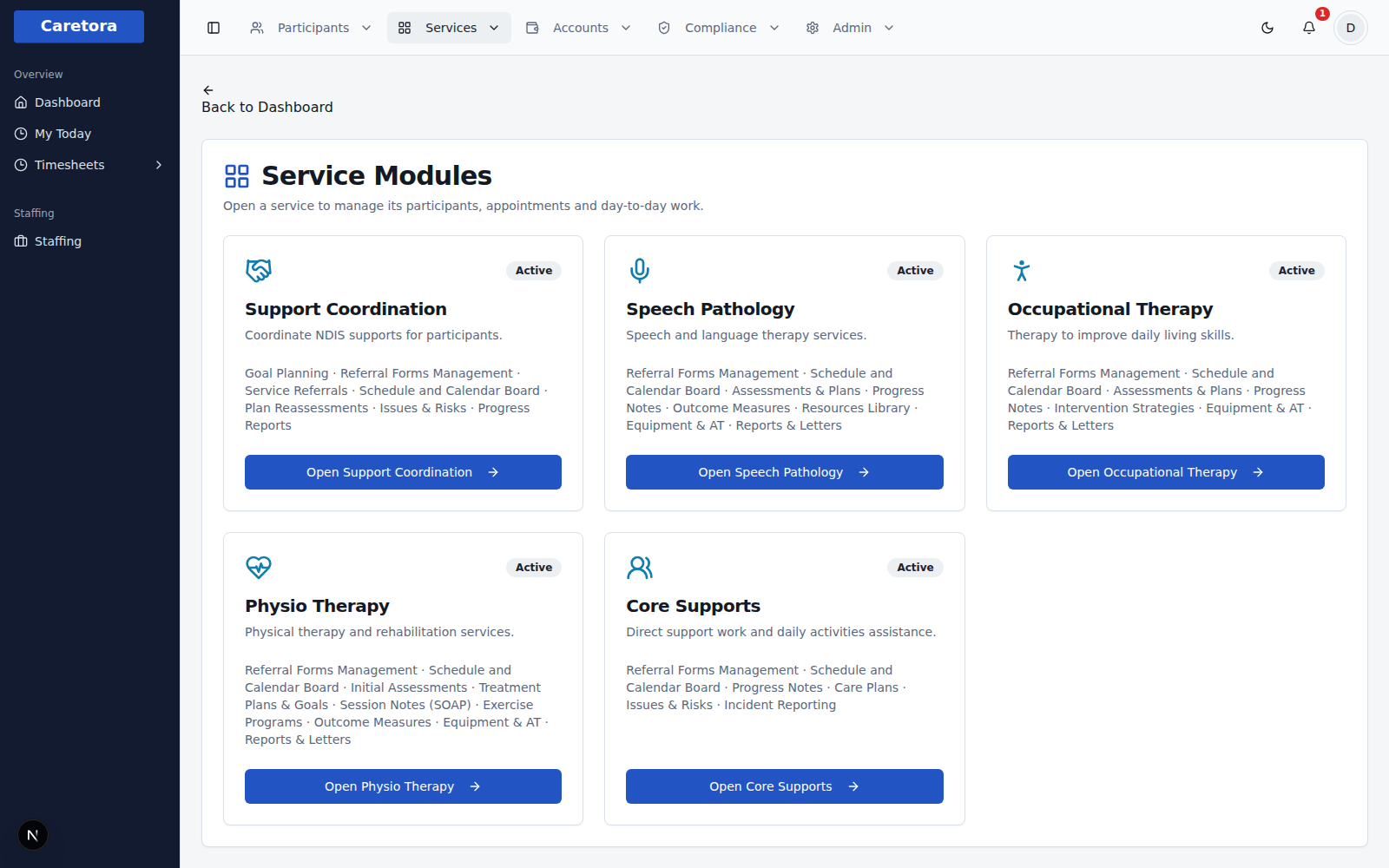
- Subscribe to just the Core Supports module
Registered NDIS provider
Building a business that will carry NDIS Commission registration.
- Audit-ready compliance tracking from day one
- SCHADS-aware rostering as you take on staff
- A full audit trail on every record, ready for review
What running the admin side usually looks like — and what changes
Most of the pain starting out isn't the support work itself — it's stitching together tools that were never meant to work as one system.
Bookings live in one calendar app, invoices get raised in a separate tool, progress notes go in a notebook or a generic notes app — and a single session's details get typed out three times in three different places.
Bookings, progress notes, and the invoice or NDIS claim for that same session live in one record — write it once, and it's there everywhere it needs to be.
A generic invoicing tool doesn't know NDIS support item numbers or current price limits — every claim gets built by hand, line by line, with every chance for a typo to cause a rejection.
Invoices and claims are built from the support item and rate already attached to the session, not re-entered by hand.
Getting registered — or staying compliant once you are — means tracking worker screening, insurance, policies and incident records somewhere auditable. Most new providers keep this in folders and hope nothing's asked for suddenly.
Compliance documents, staff credentials and incidents are tracked with expiry dates and a full audit trail from day one, so the records are already in order when an audit happens.
Most provider platforms charge one all-inclusive price built around a 30 or 50-person organisation, which makes no sense whether you're solo or just hiring your first few staff.
Subscribe to the module you actually deliver, and add role-based access as you bring on staff — pay for where your business is today, not where a platform assumes it should be.
On-the-day work happens on a phone, but the booking, the directions and the note-writing are three different apps, none of which were built for working from a car between visits.
The Caretora mobile app shows today's bookings, gives directions, clocks you in and out, and takes the session note — all from the one app.
Ready to set up your NDIS business?
Start a free 3-day trial, or get started to have your organisation onboarded — no obligation to the full platform until you need more than one module.